


Fire Brake Fire-Resistant Grass Seed Mix
Fire Brake Fire-Resistant Grass Seed Mix
Low-growing, drought tolerant grasses for defensible space around rural homes, barns, and outbuildings
Creating a natural fire resistant grass seed barrier around rural homes, barns, and outbuildings can significantly reduce wildfire risk. Fire Brake is a professionally formulated fire resistant lawn seed mix designed for defensible space and fire-prone areas.
This cool-season blend contains low-growing, drought tolerant grasses selected to stay green longer and go dormant later than many invasive weeds. By reducing excess dry vegetation and fine fuel loads, Fire Brake helps create a safer, more fire-resistant landscape around your property.
Couldn't load pickup availability
Select your land size and seeding method to see your suggested seed quantity
How much do I need?
Best use
Defensible space around rural homes, barns, and outbuildings in fire-prone areas. Also planted on hillsides for erosion control and along property perimeters to create buffer zones. When combined with proper defensible space practices, Fire Brake can significantly reduce wildfire spread and help protect structures.
Mix details
Seeding details
- Drill rate
- 16–20 lbs/acre
- Broadcast rate
- 20–25 lbs/acre
- Annual rainfall
- 12"+ a year
Cool-season grasses are best planted in early fall or early spring. Adequate soil moisture improves establishment success.
- Remove weeds and brush Clear invasive weeds and brush before planting.
- Seed for dense coverage Drill at 16–20 lbs/acre or broadcast at 20–25 lbs/acre. Dense coverage reduces bare soil.
- Keep it mowed Maintain mowing height to prevent tall, dry growth.
- Water during establishment Irrigate appropriately while the stand is getting established.
- Combine with fuel reduction Pair with tree pruning and other fuel reduction practices.
- Make it part of a plan Fire resistant landscaping works best as part of a complete wildfire mitigation plan.
What mix should I buy?
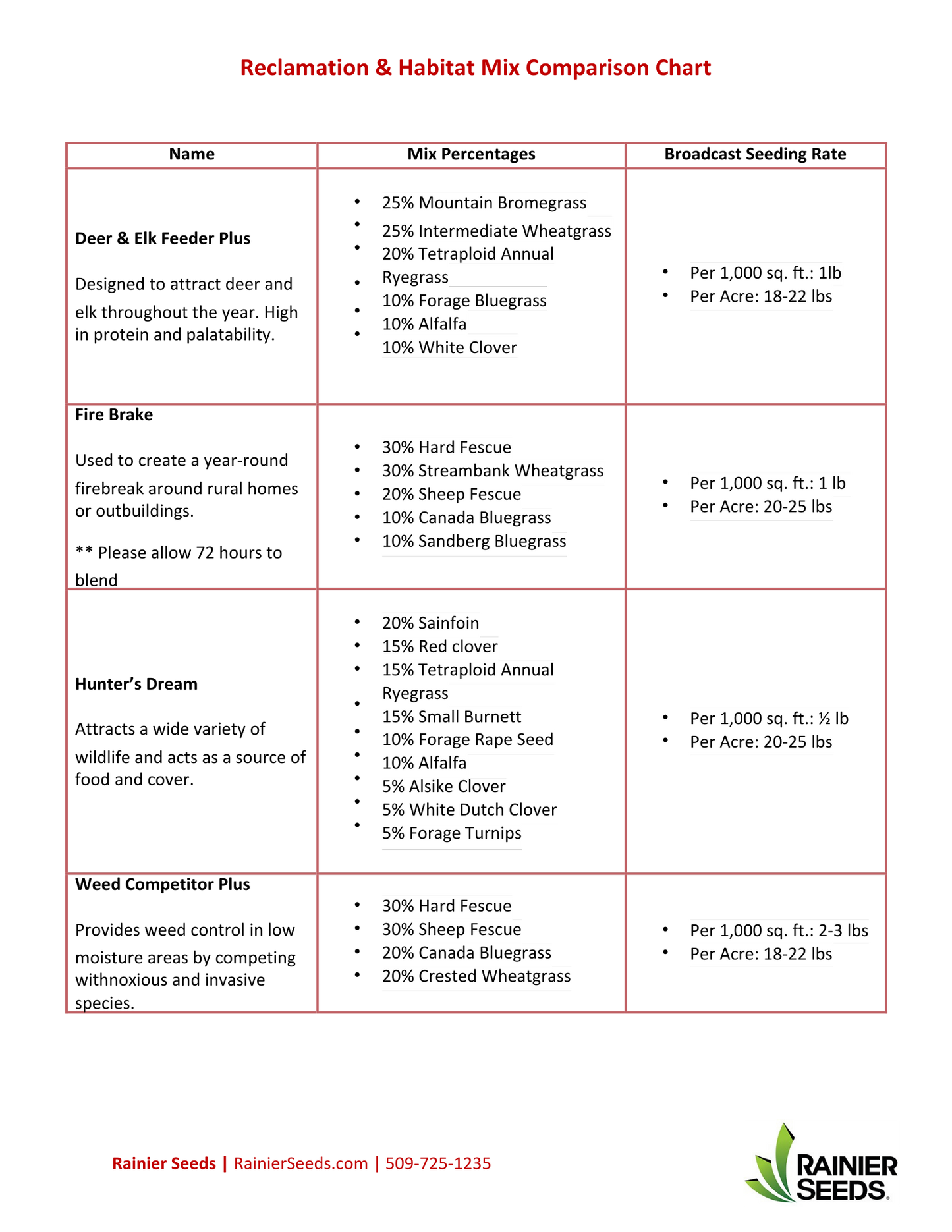
Compare our other habitat & reclamation mixes with our comparison charts below
Shipping & returns
Shipping
Free standard shipping on all seed orders within the contiguous United States — no minimum order. Seed ships from Davenport, WA.
Processing takes 1–2 business days. After that, allow 4–10 business days for standard shipping or 7–13 for economy. You will get a tracking number by email once your order is on its way.
Bulk seed is heavy and may need special handling in transit. If your order arrives damaged, contact us within 7 days of delivery with photos and we will make it right. Read the full shipping policy.
Returns
You have 30 days after receiving your item to request a return. To be eligible it must be unopened, in its original packaging, and in the same condition you received it.
You are responsible for the cost of shipping the seed back to 1404 4th Street, Davenport, WA 99122. We issue a refund for the full invoice total. To start a return, email rainierseeds@rainierseeds.com. Read the full refund policy.
- Ships in 1–2 business days
- Free shipping on all online orders
- 30-day returns
- Blended and bagged in Washington



Why Fire Brake
Drought Resilient
Thrives with minimal water while maintaining dependable ground cover through dry conditions.
Low Fuel Growth
Naturally low-growing to reduce vegetation height and limit wildfire fuel loads.
Longer Green Season
Stays active later than common weeds, reducing early-season dry fuel buildup.
Erosion Control
Deep-rooted grasses help stabilize soil, reduce runoff, and protect vulnerable slopes.
Built for Fire-Prone Landscapes
Specifically designed for regions where vegetation management and wildfire risk matter most.
Frequently Asked Questions
When combined with proper defensible space practices, Fire Brake can significantly reduce wildfire spread and help protect structures.
Well-managed grasses create shorter, less dense fuel compared to unmanaged brush or weeds. By maintaining a low-growing, drought tolerant grass cover, you reduce dry biomass that can carry fire toward structures.
This mix is comprised of predominantly bunchgrasses, meaning the stand won't naturally sod out or create more of a path for fire to spread.
Fire resistant grass seed is commonly planted:
- Around homes in rural or wildfire-prone areas
- Around barns and outbuildings
- On hillsides for erosion control
- Along property perimeters to create buffer zones
Cool-season grasses are best planted in early fall or early spring. Adequate soil moisture improves establishment success.
To maximize effectiveness:
- Remove invasive weeds and brush before planting.
- Establish dense coverage to reduce bare soil.
- Maintain mowing height to prevent tall dry growth.
- Irrigate appropriately during establishment.
- Combine with tree pruning and fuel reduction practices.
Fire resistant landscaping works best as part of a complete wildfire mitigation plan.
Yes. Fire Brake is designed for drought-prone, wildfire-risk regions including California, Oregon, Washington, Idaho, Nevada, and other Western states.
No vegetation is fully fireproof. Fire Brake is designed to reduce fuel load and fire intensity when properly maintained. It should be used alongside other defensible space practices such as brush removal and tree spacing.
Grass varieties that:
- Produce less fine dry matter
- Stay green longer into dry seasons
- Grow lower to the ground
- Compete against invasive weeds
These characteristics reduce flame height and slow fire spread compared to unmanaged vegetation.
Native grasses may support ecological restoration, while a fire resistant grass seed mix is specifically selected to reduce fuel load and improve defensible space performance. Fire Brake is designed with wildfire mitigation as the primary goal.
Drilled at 16–20 lbs/acre, one bag covers roughly 0.3 acres. Broadcast at 20–25 lbs/acre, about 0.2–0.3 acres.